Este site utiliza cookies para melhorar sua experiência. Presumiremos que você concorda com isso, mas você pode cancelar se desejar. consulte Mais informação


So here goes my first blogpost.
I’m going to try to establish a poetic link between the embroidery project that I’m bringing you here, and which marks the start of this space, and the story of “how it all began”, but as I’m not much of a writer, I’ll try my best.
Much has been said about the creative act that comes from Nothing, about how human beings carry within them the urge to fill an empty space. This feeling doesn’t affect everyone in the same way, but since you’re on this page reading these words, I’m guessing that a similar feeling has brought you here.
Many months ago I bought a frame that I thought was beautiful, without having a concrete purpose for it. I was convinced that I would finally go through the thousands of photos on my phone to print one of them out and display it on the living room shelf. So many months passed and the frame was there, a white canvas staring me in the face, with a mixture of disapproval and hope for a more rewarding future.
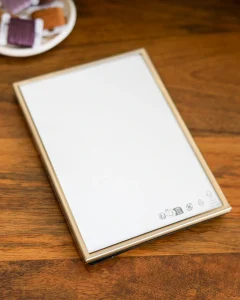
At the same time, I was going through a similar situation at work. The emptiness of the frame was a mirror of the emptiness I felt about my job, my purpose and my place.
And then something happened, I made a decision and went ahead. Fearfully, of course, aware of the risks and challenges that awaited me, casting fleeting glances backwards, but always moving forwards, moving away from what was and towards what would be. And so the Embroidery Concept Store came into being.
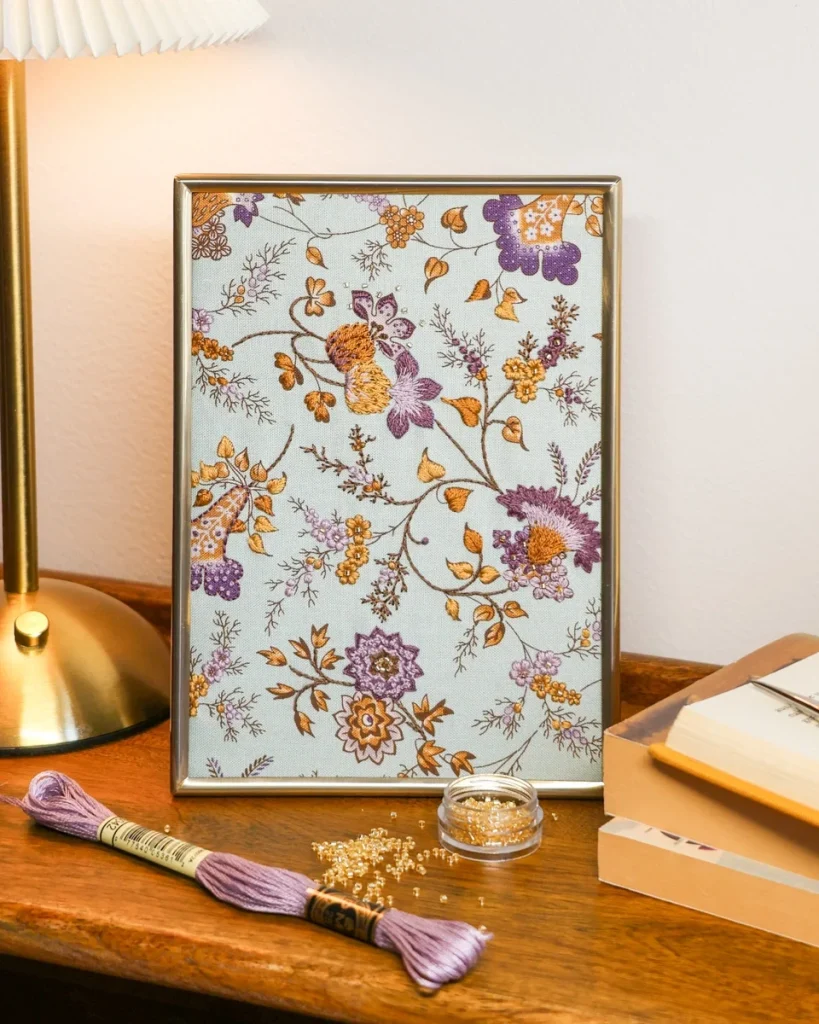
Returning to the frame, I realized that it didn’t only have to be used for photos, that I could frame whatever I wanted. I remembered a piece of printed fabric I had bought a few months ago. The floral pattern invited free embroidery. Yes, free, because what I felt like embroidering, I would embroider, other motifs that I found too complex I could simply ignore, and that wasn’t why the end result wouldn’t be beautiful.
The frame is 13 x 18 and I thought that Nurge’s lilac frame No. 2 (made of sturdy plastic) would be the best option to hold the fabric I had cut out, leaving a wide margin all around. I knew right away that I didn’t want to deviate too much from the original colors, because I liked the idea of creating relief and texture that wasn’t obvious at first glance. I glanced inside my DMC Mouliné yarn organizer and the shades immediately jumped out at me (this is one of my favorite parts: finding the right color in the midst of so many others, like looking for a puzzle piece, which is another thing I love to do): 3828, a perfect gold that I love, 420 hazelnut, 839, a more neutral dark brown, and finally the two brothers 3740 and 3042, two purples with a more grayish tone that contrasts with the other warmer ones.
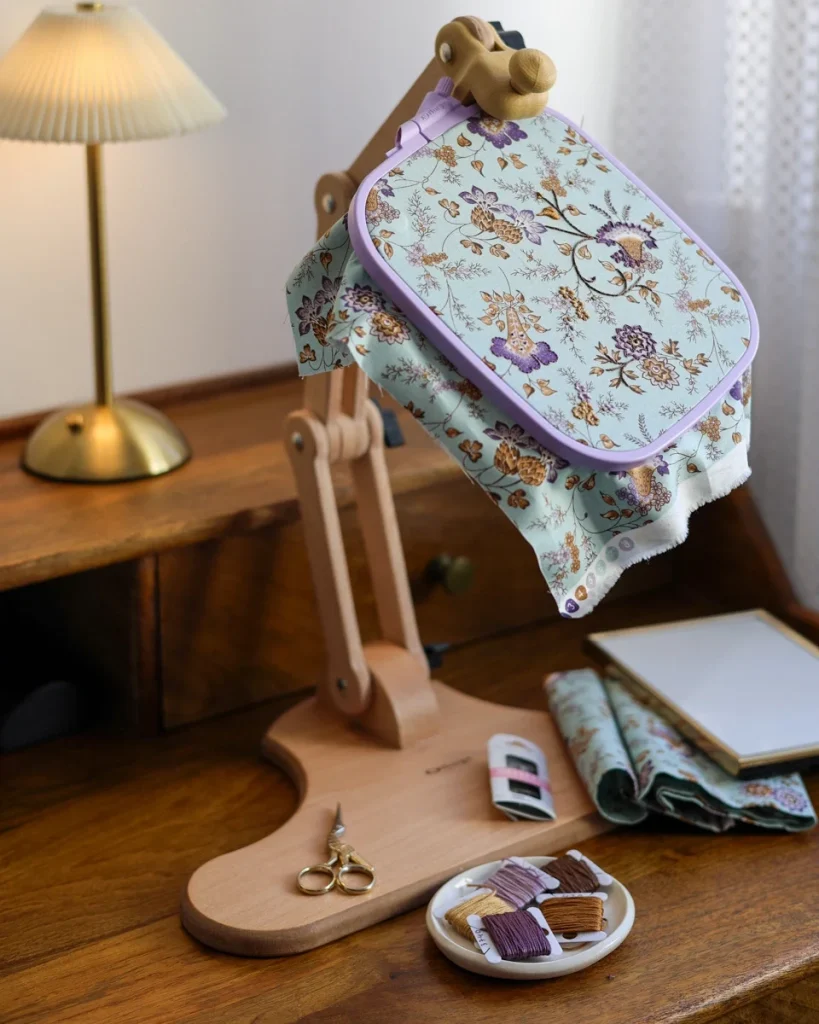
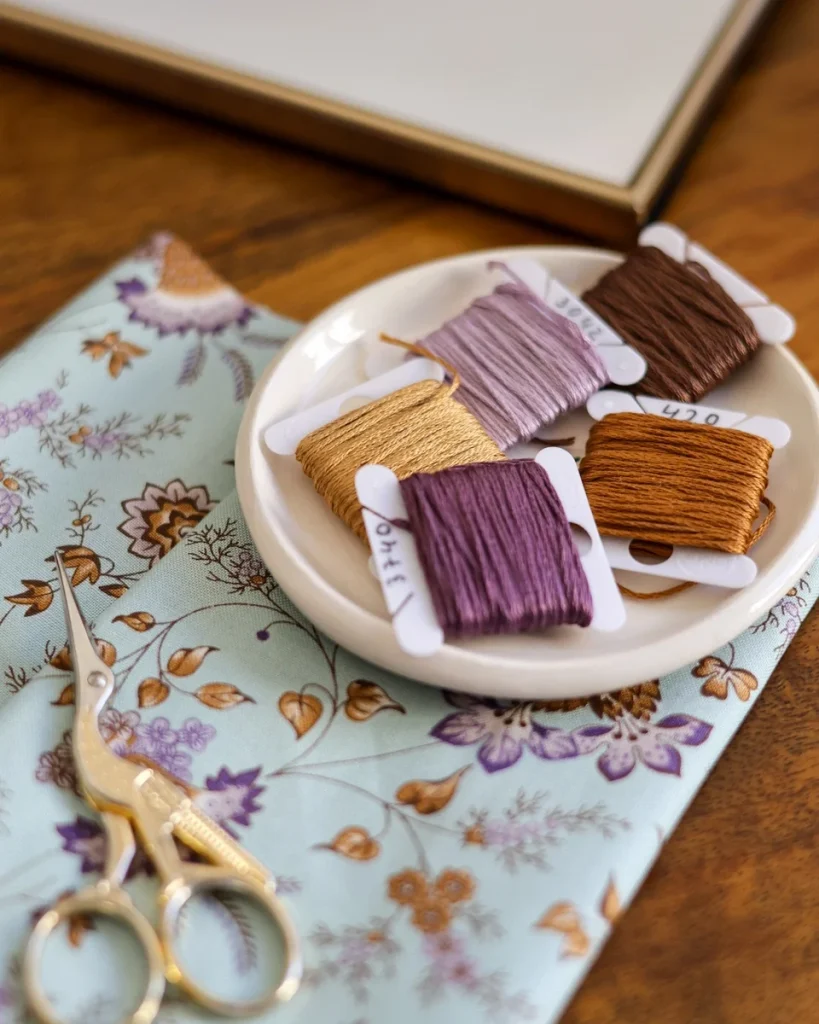
After the easy part, came the hard part: with no instructions or example to follow, what on earth was I supposed to embroider now? I looked at the little flowers and recognized the opportunity to do daisy stitch on some and full stitch on others. For the outlines I would use backstitch, the dots would have a French knot, the leaves would be embroidered with leaf stitch and the stems with the classic stem stitch.
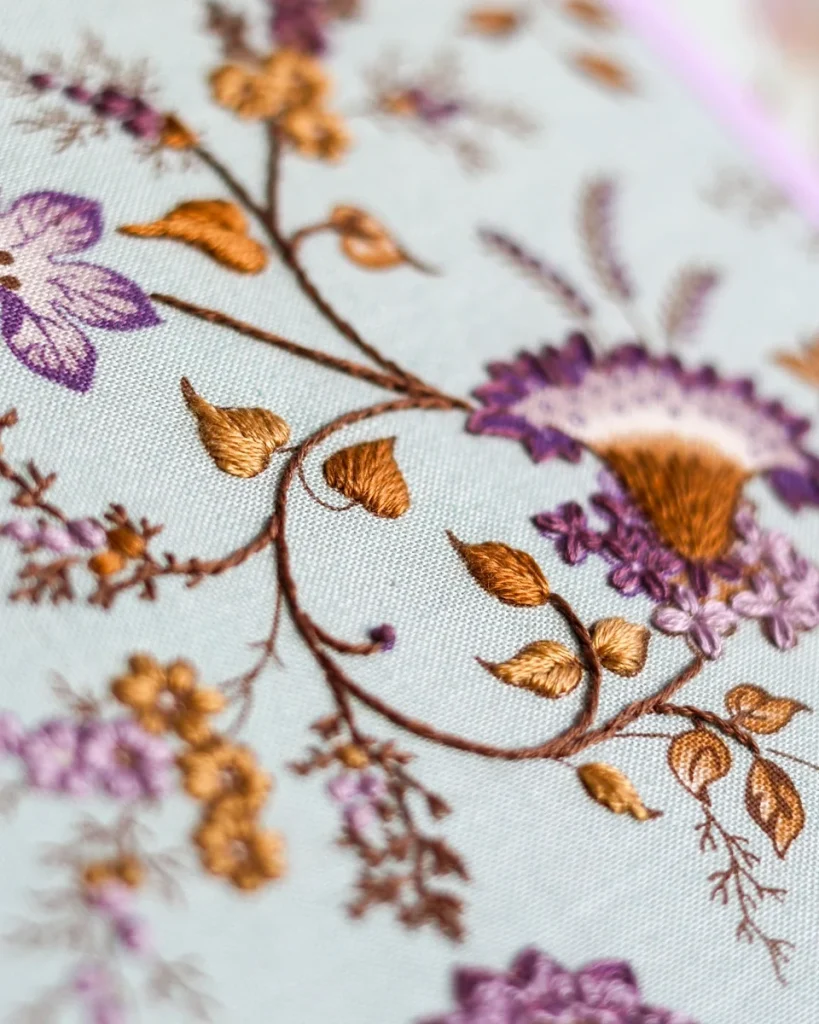
Then it was a question of assessing how I could achieve a balanced look between the embroidered and unembroidered parts. Although I had intentions of planning how I would proceed, I spent the whole time questioning myself and changing my mind. It was a real back and forth, but one that, in my opinion, is part of the experience. It’s like a jigsaw puzzle, which is only put together once you’ve tried a lot of wrong pieces.
And so I carried on, deciding later that I should venture a little into needlepainting, an advanced technique that I rarely use (out of respect for those who do it so well, unlike me, and for fear of failing miserably). It involves straight stitches that alternate between short and long, making color transitions possible. The most important thing is to direct the stitches to create the desired movement. What helps a lot is to trace the direction the threads should take with a pen, drawing guidelines.
Finally, I chose some Delica 11/0 glass beads from Miyuki, in the color DB1212 (a yellow gold) to finish off some of the flowers and give them a more interesting, glossy finish.
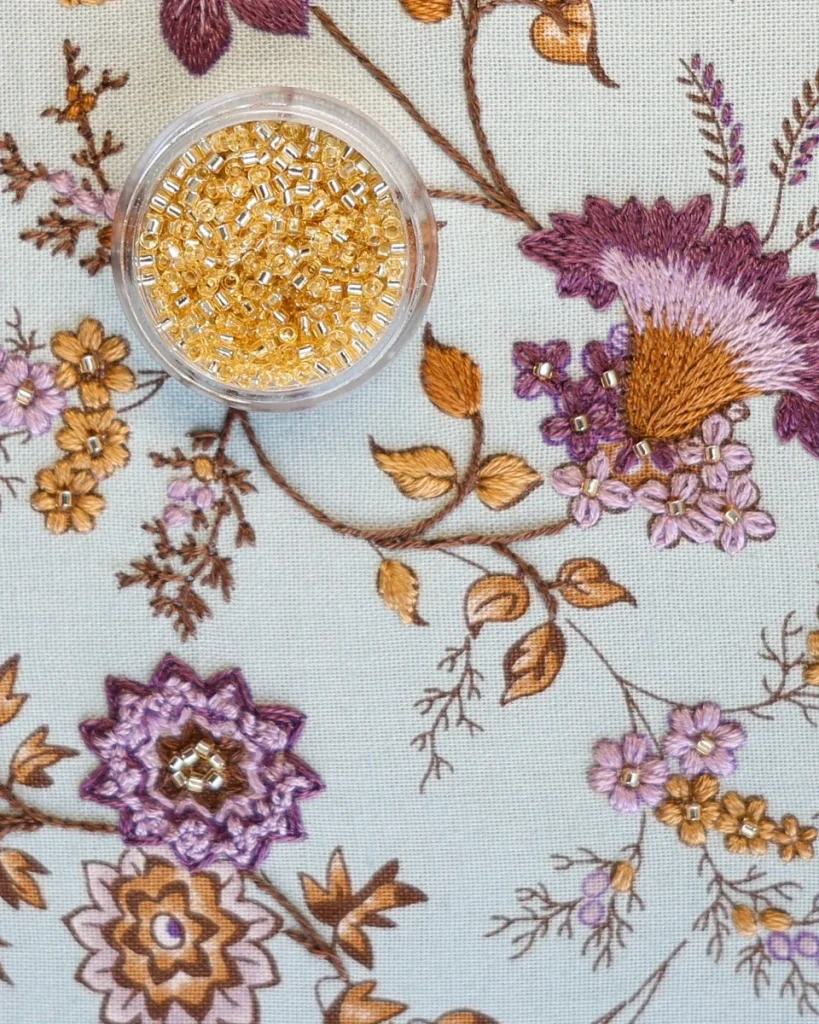
As the design was very small, I always used a maximum of 1, 2 or 3 threads (as the embroidery threads in the Mouliné range are made up of six divisible threads).
I hope you like the end result as much as I do and that you feel inspired to pick up the needle, because the frame has made up with me. And me with it.
See you soon!
Your Inês